1. The deadlift, the squat and anything you hold your breath for
Heavy lower-body lifts put the most downward pressure on your pelvic floor of anything in the gym. The problem is rarely the weight itself. It is the breath-hold that comes with it — the brace that pushes everything down while your pelvic floor is still catching up.
The swap: go lighter and breathe out on the effort. A goblet squat to a box with a moderate weight, or a trap-bar deadlift at a weight you could do twelve of. Set your pelvic floor before you lift, breathe out as you stand up, release at the top.
When you come back to real weight, add it in small steps and watch the pad. If a heavier set leaves you damp when the lighter one didn't, that is your ceiling for now. It moves.
2. Sit-ups, crunches and leg raises
Classic ab work pushes your abdominal wall down and in, straight onto the bladder. Leg raises are the worst of the group because your pelvic floor gets no chance to help. Many men find these are the exercises that produce a leak when nothing else in the session does.
The swap: dead bugs, bird dogs, and a side plank from the knees. These ask the deep abdominal muscles to hold steady rather than crunch. They work with your pelvic floor instead of against it.
A simple test: if you can't keep breathing normally through the movement, it is too hard for now. Regress it until you can talk through the set.
3. Jumping, skipping and running downhill
Impact is the other big one. Every landing sends load through the pelvic floor faster than you can consciously brace for it. Skipping ropes, box jumps, burpees and downhill running all land in this group. Running on the flat may be fine when the rest is not — it depends on the man and the stage.
The swap: the rower, the cross-trainer, the bike, or a brisk uphill walk on a treadmill. You will get your heart rate where you want it without the repeated thud.
Come back to impact in small doses. Thirty seconds of easy skipping at the end of a session tells you more than a full class does, and costs you far less if the answer is not yet.
4. Full-swing driver practice at the range
A golf swing is a fast, forceful rotation with a hard stop. On the course you take fourteen of them across four hours. At the range you might take sixty in forty minutes, all with the big stick. That volume is what catches men out, not the game itself.
The swap: start your range sessions with wedges and short irons, and keep the driver to the last handful of balls. Half swings first. Build up the number of full swings week by week rather than the club length all at once.
Brace just before the takeaway, not during the swing. Trying to hold a squeeze through the whole motion will wreck your tempo and won't help your bladder either.
5. The long saddle ride
Cycling itself is usually fine. The issue is sustained pressure on the perineum — the area between your legs — over an hour or more, especially on a narrow racing saddle with your weight tipped forward. Some men notice numbness, some notice more leaking after a long ride, some notice nothing at all.
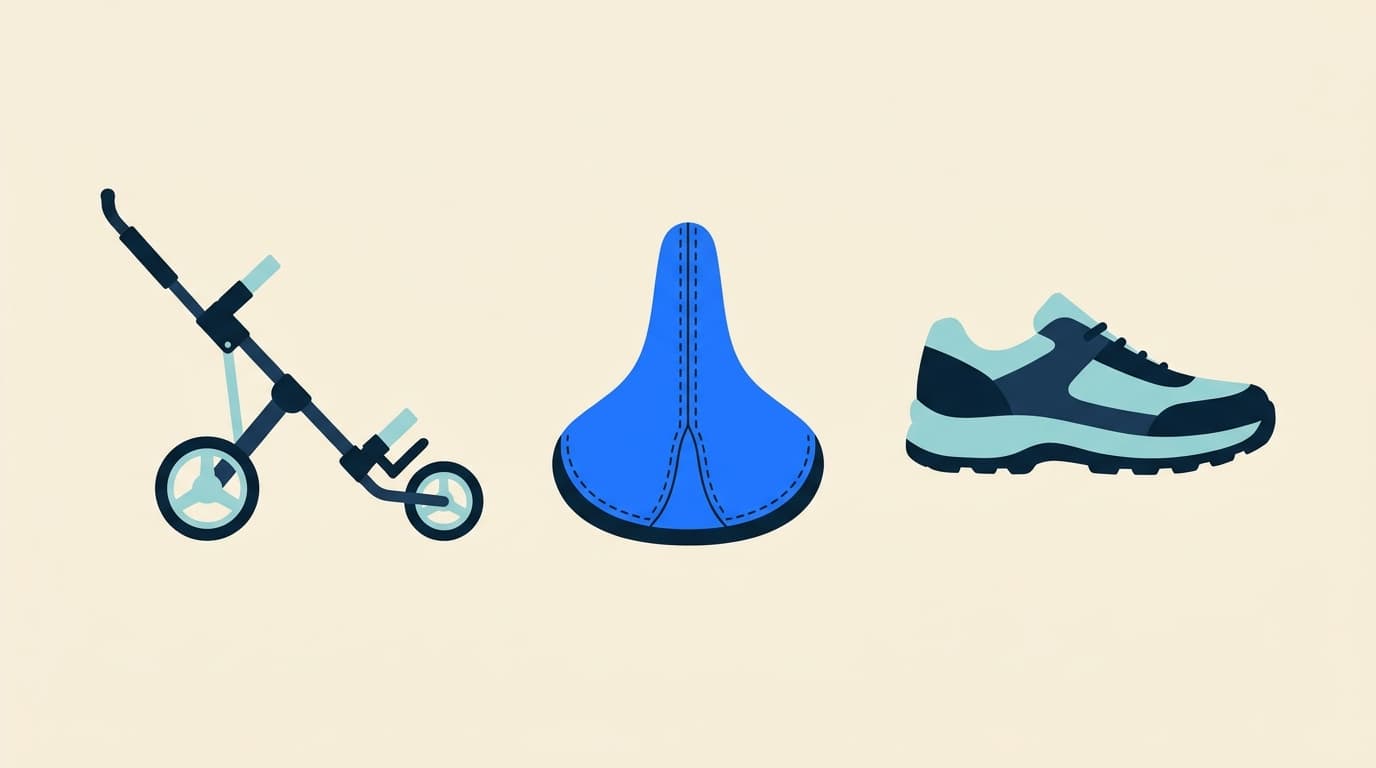
The swap: a wider saddle, or one with a central cut-out, and get the nose angled very slightly down. Raise the bars if you can. Then ride half the distance you used to and stand on the pedals for a few seconds every ten minutes.
If numbness or pain in that area turns up and doesn't clear within a short while of getting off the bike, stop riding and speak to your doctor about it rather than adjusting the saddle again.
Also worth reading: Back to the Walk, the Gym, the Bike and the Tee: A Five-Stage Return · The Knack: How to Brace Before a Cough, a Lift, or Standing Up
6. Overhead pressing
Pressing a weight overhead makes you brace hard through the middle, and the load travels straight down your spine and into the pelvic floor. Standing barbell presses are the version most likely to produce a leak.
The swap: press seated with your back supported, and use dumbbells so you can go lighter than a bar allows. Breathe out as the weight goes up. Keep your ribs down rather than arching your back.
Standing presses come back. They just come back after the seated ones feel easy, not before.
7. Carrying the golf bag, and the gym equivalent
A carry bag over one shoulder for eighteen holes is a long, asymmetric load. So is a heavy farmer's carry or lugging a loaded sled around. The pressure isn't dramatic, but it goes on for a long time, and fatigue is when leaks appear.
The swap: an electric or push trolley for a few rounds. In the gym, carry lighter weights for shorter distances and split the load between both hands. Set down and reset rather than gritting through the last twenty metres.
If a trolley feels like a defeat, think of it as the thing that lets you play the back nine as well as the front. Plenty of men keep the trolley permanently once they realise how much fresher they finish.
Putting it together this week
Pick the one exercise on this list you do most often and swap it for the alternative. Just one. Keep everything else the same, and see what the pad tells you over a week.
Then bring the original back at a lower dose — lighter, shorter, fewer reps — rather than waiting until you feel completely ready. Waiting tends to turn into not going back at all.
Keep a rough note of what you did and what happened. Over a couple of months that note is the clearest evidence you will get that the work is paying off, and it will tell you when a swap has done its job and can be retired.