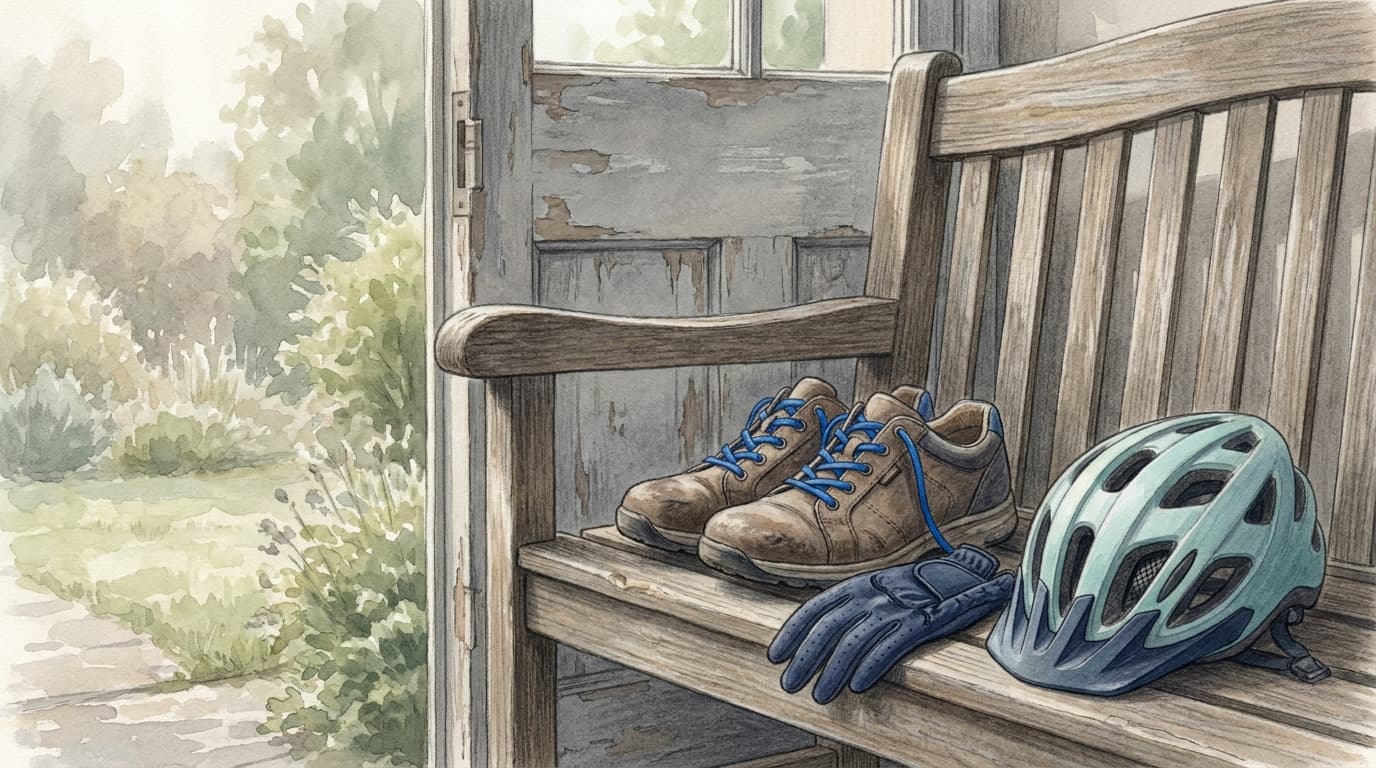
Stage 1: Walking, and the boring work of getting the load right
Walking is where most men start, and it's the right place. It's low impact, you control the pace, and you can turn back whenever you like. It also tells you something useful: whether leaks come from time on your feet, or from something sharper like a cough or a step down a kerb.
Start with a loop you know. Flat, near home, with a toilet somewhere on the route if that matters to you. Walk it, and pay attention to when you notice dampness — early, late, on the hills, or after you stop. That's information, not failure.
Then add distance before you add speed or hills. A little more each week, not double. If a longer walk leaves you wetter than usual, hold that distance for another week rather than pushing on. The pattern you want is steady and dull, which is exactly what tissue that's healing responds to.
Stage 2: The gym, starting with the machines you'd normally skip
The gym worries men because of lifting, and it should — but only the part that involves holding your breath and straining. That's the movement that pushes down hardest on the pelvic floor. Everything else is more forgiving than you'd think.
Begin with seated and supported work. Leg press with a moderate weight, seated rows, chest press, cable work. Machines let you control the load precisely, and sitting or lying down takes some of the downward pressure off. Breathe out on the effort. If you can't talk through a set, the weight is too heavy for now.
Save the heavy free weights, deadlifts and overhead pressing for later, and reintroduce them one at a time so you know which one causes trouble. Before each rep, use the brace — squeeze and lift the pelvic floor just before the effort, then let it go. It won't feel automatic at first. It becomes automatic with repetition, the same as any other lift technique.
Stage 3: Cycling, and the saddle question
Cycling is kind to the pelvic floor in one way — you're seated, and there's no impact. It's harder in another, because you're sitting directly on the area for a long stretch, and pressure there can cause numbness or aching.
A saddle with a central cut-out or channel takes weight off the middle and puts it on the sitting bones, which is where it belongs. Get the height right too: if you're rocking side to side at the bottom of the pedal stroke, the saddle is too high and you're grinding on it. Most bike shops will check this in a few minutes.
Stand on the pedals for a few seconds every ten minutes or so, especially on longer rides. It restores blood flow and breaks up the pressure. And if you get numbness that doesn't clear within a short time of getting off the bike, stop riding and speak to your doctor rather than adjusting your way around it.
Stage 4: Golf, and the one movement that catches men out
Golf looks gentle. Four or five hours of walking, a bit of standing about, a swing that doesn't involve lifting anything heavy. Most men manage the round fine and get caught by one specific moment: the full swing, particularly the driver.
A hard swing is a fast rotation with a sharp exhale and a sudden rise in pressure. That's the same mechanic as a cough, just spread over a second. The brace works here too. Set up, take your breath, squeeze and lift as you start the backswing, release once the ball's gone. Practise it on the range where nothing's at stake, because the first attempts will wreck your rhythm.
Bending to tee up and to retrieve the ball adds up over eighteen holes. Bend at the hips and knees rather than folding at the waist, and let the exhale come out as you come back up. Small thing, done a lot of times.
Stage 5: Reading what happens afterwards
The day after tells you more than the day itself. A bit more leaking in the evening after a long walk or a heavy session is common while things are still rebuilding, and it usually settles overnight. If it settles, you did roughly the right amount.
If it's still worse two or three days later, you went too far. Drop back to the last level that felt manageable, sit there for a week or two, then step up again more slowly. This is not going backwards. It's how load management works in any kind of rehab.
Keep the pelvic floor training going on top of the exercise, not instead of it. The two do different jobs — the training builds the strength and the timing, the walking and lifting teach you to use it while you're busy doing something else. Over weeks and months, most men find the bracing stops being a conscious act and starts being just how they move. That's the point at which sport stops being a calculation and goes back to being sport.