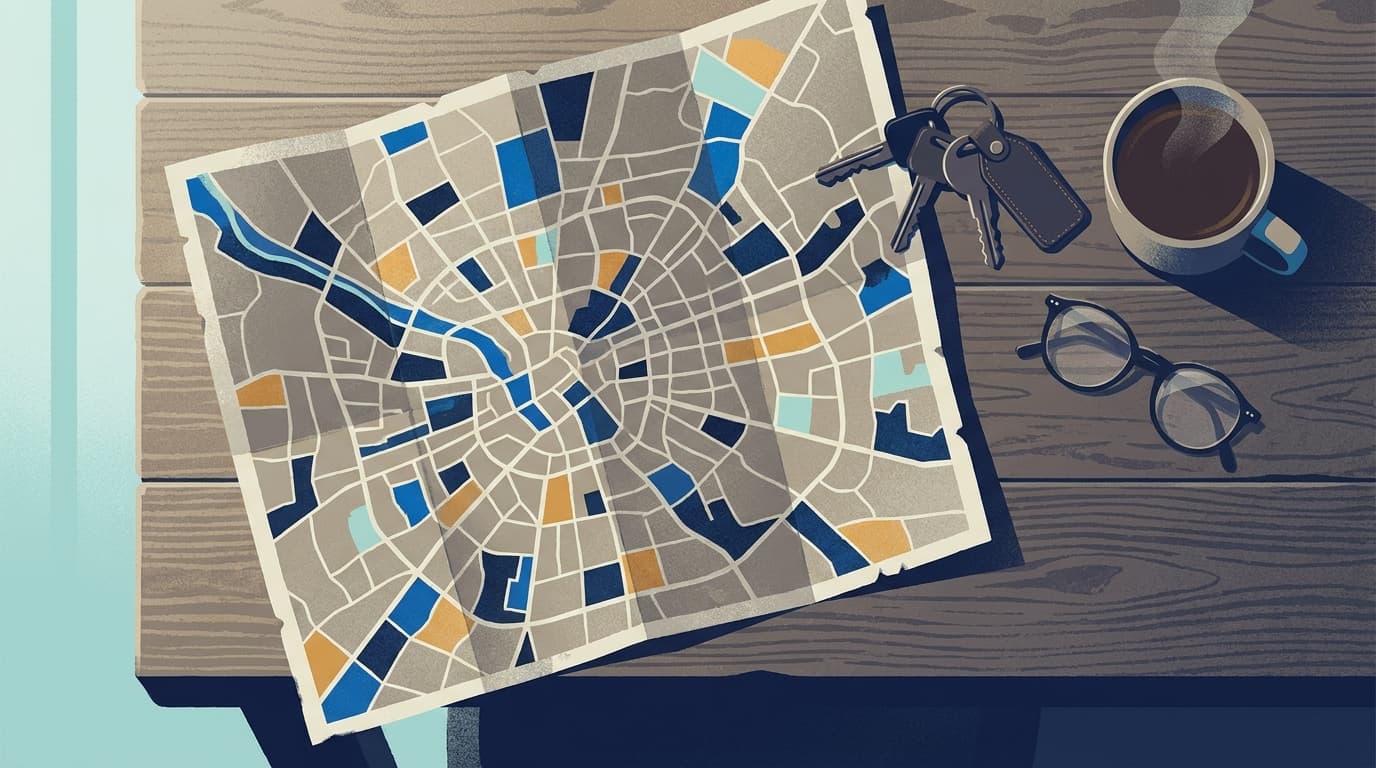
The map in your head
Most men who leak build a map without ever deciding to. The toilet in the garden centre, past the tills and left. The one in the supermarket that is usually clean. The pub you prefer because the gents is near the door, not up a flight of stairs.
The map is useful. It is also a tax. Every trip out now has a background calculation running, and that calculation costs you attention you would rather spend on the person you are with or the thing you came to do.
The fix is not to throw the map away. It is to stop consulting it first. Try this: decide where you are going and why, then check the map once, at the end, as a detail — not as the thing that chooses your destination. If a place is genuinely impossible, that is information. But most places are not impossible. They are just unfamiliar, and unfamiliar has quietly come to mean unsafe.
The seat by the aisle
Watch where you sit now. The end of the row at the cinema. The chair nearest the door at a family lunch. The aisle seat on the train, even when the window is free and the view is better.
There is nothing wrong with an aisle seat. The problem is when it stops being a preference and becomes a condition — when you would rather not go at all than sit somewhere you cannot leave quietly.
Take it back in small steps. Once, sit one seat further in. Just one. Nothing usually happens, and your body learns something your worry has been arguing against. Do that a few times and the aisle becomes a choice again instead of a requirement.
The bag you did not used to carry
Somewhere along the way you started carrying spares. A pad or two, a plastic bag, maybe a change of underwear in the car. That is sensible, and it is worth saying clearly: protection is not a defeat. It is what lets you leave the house and stop thinking about it.
The problem creeps in when the bag gets heavier every month. One spare becomes four. The car boot becomes a store cupboard. Each addition feels like caution, but the pile is really a record of how much fear you are carrying.
Set a level and hold it. Enough for the day you are actually having, plus one. Keep a fuller supply at home and in the car, not on your shoulder. And revisit it every month or so — many men find they are still packing for the worst week they had rather than the week they are in now.
The drink you turned down
This one is nearly invisible. You say no to the second cup of tea. You skip the pint after the walk. You have water at home but not out. Over months, that adds up to a smaller life and, more often than not, a more irritable bladder rather than a calmer one.
Concentrated urine tends to make urgency worse, not better. Cutting fluid feels like control and usually is not. What actually helps is spreading it out — steady through the morning and afternoon, easing off in the evening — rather than swinging between nothing and a sudden large glass.
Pick one social drink a week that you had stopped having and have it again. Notice what really happens, rather than what you assumed would happen. If certain drinks reliably cause you trouble, that is worth knowing too, but find out by testing rather than by blanket avoidance.
The just-in-case trip
Going before you leave the house is fine. Going before you leave, then again at the halfway point, then again on arrival because you are near a toilet and might as well — that is a habit training your bladder to signal earlier and louder.
A bladder that is emptied at the first faint hint learns to send that hint sooner. Over time the comfortable gap between trips shrinks, and it shrinks because of the habit, not because anything got worse.
Start reclaiming the gap gently. When the urge arrives and you know it is early, stop moving, sit or stand still, breathe out slowly, and hold a gentle pelvic floor squeeze for a few seconds. Urgency usually comes in waves. Let one wave pass, then walk — do not rush — to the toilet. You are not trying to hold on heroically. You are teaching yourself that the first signal is not an order.
The invitation you let go
This is the costly one. The golf day you did not reply to. The christening you sent your apologies for. The friend you have not seen since spring because meeting means a pub, and a pub means the calculation.
Declining is quiet and no one questions it. That is exactly what makes it dangerous — it never gets challenged, so it grows. And the smaller the circle gets, the more the leaking feels like the main fact about you rather than one thing you are managing.
Say yes to one thing this month that you would have ducked. Go prepared: protection you trust, a spare in the car, a plan for where you will sit and when you will visit the gents on your own terms. Prepared is not the same as anxious. The point is not to prove you are fine. It is to get one more ordinary afternoon back, and then another.
Taking the day back, one edit at a time
You do not undo six habits in a week, and you should not try. Pick the one that costs you most — for most men it is the last one — and work on it for a fortnight while everything else stays as it is.
Keep training alongside it. Daily pelvic floor work is what changes the underlying picture, and bracing before a cough, a lift or standing up is what buys you confidence in the moment. The habits above are what stop your day shrinking while that work does its job. Many men find the two pull in the same direction: as control improves, the map matters less, and as the map matters less, you get more chances to practise in real life.
And keep a note of what you got back. The window seat. The second cup of tea. The Saturday you did not spend at home. Progress in this is rarely a dramatic moment. It is a list of ordinary things quietly returning to your week.