Learn the brace before you need it
The brace is one movement. You lift the muscles you'd use to stop yourself passing wind, and draw them slightly forward, as if shortening the base of your body. Nothing else moves. Your buttocks stay soft, your thighs stay soft, your face stays soft. You keep breathing.
Practise it sitting in a quiet chair first, with no pressure on it. Lift, hold for a second or two, let go completely. The letting go matters as much as the lift. A muscle you never release gets tired and stops answering when you call it.
Once you can find it sitting, find it standing. Standing is where you'll actually need it. A brace that only works in an armchair is no use at the kitchen sink.
The cough and the sneeze
A cough is a sudden shove of pressure downwards. If the floor is slack when that shove arrives, some urine goes with it. If the floor is already lifted, it has something to push against.
You almost always get a warning. There's a tickle, a breath drawn in, a half-second before it happens. Use that half-second: lift, then cough. Turning your head over your shoulder helps too, and puts a little less pressure straight down.
Sneezes give less notice, so make it a reflex through repetition. Every time you feel a cough coming — in the car, at the television, mid-conversation — lift first. Do it fifty times and you stop having to think about it.
Standing up out of a chair
This one catches a lot of men, and it's often blamed on the chair. Low, soft seats are harder because you fold further forward and press harder through your middle to get up.
Brace before you move, not as you move. Sitting still, lift. Then shift your weight forward over your feet, push up through your legs, and hold the lift until you're upright and settled. Then let go.
Getting out of a car is the same movement with a doorframe in the way. Swing both legs out first so you're facing forward, brace, then stand. Trying to twist and rise at once loads everything at the wrong angle.
Lifting, carrying and putting down
Shopping bags, a grandchild, a bag of compost, a suitcase into the boot. Any lift raises the pressure inside your abdomen, and that pressure has to go somewhere.
Brace before you take the weight. Breathe out as you lift — holding your breath and straining sends the whole load downwards. Keep the object close to your body and let your legs do the work.
Putting things down catches men out more than picking them up, because the job feels finished and the brace drops early. Hold it until the weight is on the floor and your hands are off it.
The key in the door
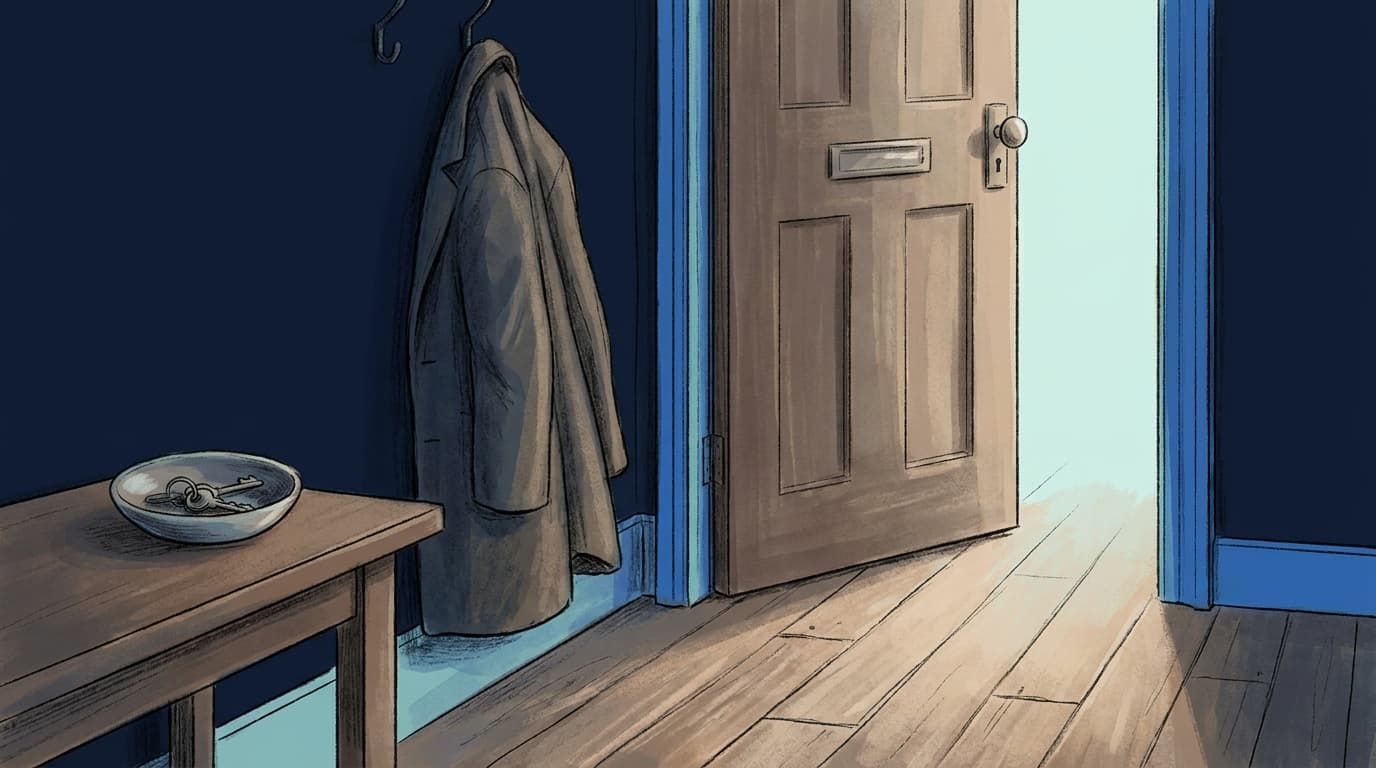
Many men are fine on the walk home and start leaking on the doorstep. The bladder learns the cue. Front door, kitchen tap, the sound of the car keys going in the bowl — the urge arrives on schedule because you've taught it to.
Don't rush for the toilet. Rushing makes the urge sharper and the leak more likely. Stop where you are. Brace, hold for a few seconds, let the wave pass, then walk at a normal pace.
Do it the same way each time and the cue starts to lose its power. You're not fighting your bladder. You're teaching it that the front door isn't a signal to empty.
Laughter and the moment you can't plan for
This is the unfair one. Laughing is repeated bursts of pressure, and you rarely get a warning, and bracing hard is the surest way to stop yourself enjoying the moment.
What helps is not tensing at the first joke, but building the habit elsewhere. The men who cope best with laughter are the ones who've braced for a hundred coughs and lifts, until some of it happens without instruction. You can also sit down, cross your legs, and lean slightly forward — small things that take some load off.
If it happens, it happens. Deal with it quietly and go back to the conversation. One leak in an evening is not the measure of your progress.
Where to take this next week
Pick one moment. Just one — the chair, or the front door, or the shopping bags. Brace for that moment every single time it comes up for a week, and ignore the others.
One repeated moment builds a reflex faster than six occasional ones. When it starts happening without you thinking, add the next moment. This is slow work and it is meant to be.
If something changes suddenly — pain, blood, a fever, or control that gets noticeably worse over a few days — that's a conversation with your doctor, not something to train through.