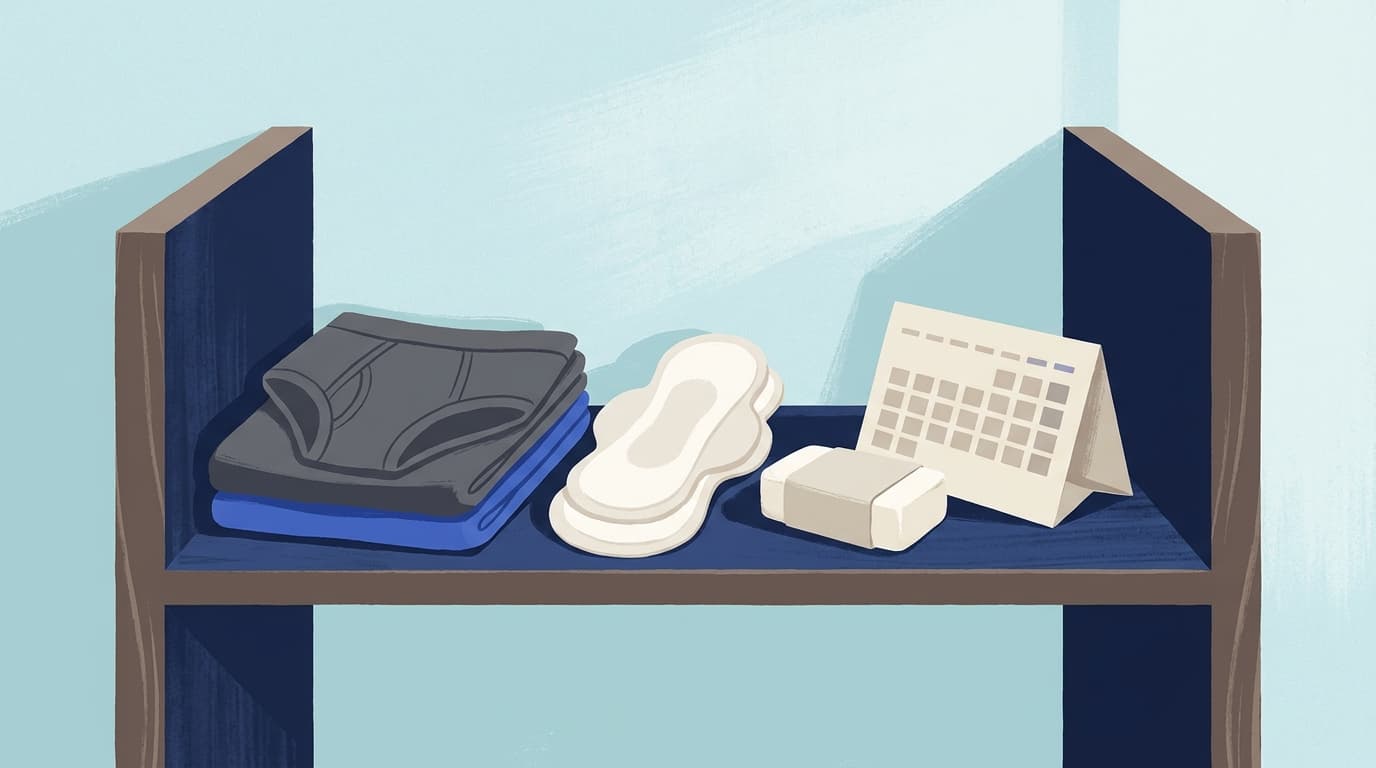
Stage 1: Find out what you are actually using
Before you change anything, you need a week of honest information. Most men have no idea how many pads they use. They know it's "a few", and they buy in bulk so they never have to think about it.
For seven days, keep a note. A pencil mark on a bit of card in the bathroom is enough. One mark per pad changed. If you want the number that matters most, also write down whether the pad was soaked, damp, or barely marked when you changed it.
That second detail is the one that does the work. A man using four pads a day where three are barely marked is not a four-pad man. He is a one-pad man with a changing habit. Those two situations need completely different plans.
Stage 2: Get the size right before you get the number down
A lot of men are wearing far more protection than their leaking calls for. It usually happens in the first weeks after surgery, when leaking is heaviest, and then nobody revisits it. You bought the big ones, they worked, you kept buying them.
Protection made for men is shaped differently from protection made for women, and it sits better. Guards and shields are the smaller end. Then there are larger pads, then absorbent underwear. Within each type there are absorbency levels, usually marked with drops or a number.
If your pads are consistently coming off damp rather than heavy, drop one level. Not two. Try it on a normal day at home first, not on the day of your daughter's wedding. If it holds, that is your new baseline. If it doesn't, go back up and try again in a few weeks. Nothing is lost.
Stage 3: Change on evidence, not on the clock
Some men change every two hours regardless, because it feels clean and safe. It is understandable. It is also how you end up carrying a bag everywhere and spending more than you need to.
Modern absorbent products hold more than they feel like they hold, and the surface layer is designed to stay dry against the skin. A pad that feels a bit warm is not necessarily a pad that is finished.
Change when there is a real reason: it feels wet against you, it feels heavy, you can smell it, or you have had a big leak and know it. Otherwise leave it. Two caveats worth taking seriously — if your skin is sore, red, broken, or itching, change more often and speak to your doctor, and if the smell is strong or the urine looks cloudy or bloody, that is a doctor's call, not a pad decision.
Stage 4: Look after the skin underneath
Skin that is wet for long stretches gets fragile. It stings, it chafes, and once it is sore you start changing constantly out of discomfort, which sends you backwards on everything else.
The routine is simple. Rinse with water or use a gentle wash rather than ordinary soap, which strips the skin. Pat dry, don't rub. Let the area air for a minute if you can — sitting on the edge of the bed for a moment after a shower does the job. A barrier cream can help if you are prone to soreness, but use it thinly, because a thick layer stops the pad absorbing.
Cotton underwear over the top, not tight nylon. Air matters more than most men expect. If soreness doesn't settle in a few days, or the skin breaks, get it looked at rather than trying more products.
Stage 5: Match the protection to the day, not to the worst day
Most men wear their worst-day protection every day. It is the safe choice, and it is why the drawer never changes. But your days are not identical, and your leaking probably isn't either.
Think in three tiers. A heavy day is one with lifting, a long walk, a gym session, sport, coughing, or a lot of standing. A normal day is work, errands, driving. A quiet day is sitting at home, no exertion, close to a toilet.
Try tiering down on quiet days first. That is the lowest-risk place to experiment, because you know exactly where the bathroom is and you can change in thirty seconds. Once a lighter product survives a quiet day repeatedly, try it on a normal one. Heavy days stay as they are for now. You are not being brave, you are being accurate.
Stage 6: Test a lighter option properly, in a way that can't embarrass you
The reason men don't step down is the fear of one bad moment in public. That fear is rational, so build the test so it can't happen.
Pick a two-hour window at home. Wear the lighter product. Do what you would normally do, including standing up from chairs and going up stairs, because that is when stress leaks arrive. Keep the heavier product in the bathroom, not in a bag on the other side of town.
Repeat that across three or four days before you take it out of the house. Then take it out for a short trip — the shop, the walk round the block — with a spare in your coat pocket. This is slower than switching in one go. It also works, because you never get the scare that sends you back to the biggest pad in the drawer for another six months.
Stage 7: Keep the pad and the training pointing the same way
Protection manages the consequence. Pelvic floor training works on the cause. They are not in competition, and using a pad does not mean you have given up on improving.
But there is one trap. If the pad handles everything invisibly, you can stop noticing what your body is doing — which leaks happened, when, and what triggered them. That information is what tells you whether the training is landing. So keep glancing at the pad when you change it. Damp rather than soaked is progress. Fewer changes on the same kind of day is progress.
Progress is rarely a straight line. A hard week at work, a cold with a lot of coughing, a long drive — any of these can put you back up a level for a while. Going back up is not failure. It is the right response to a harder week. Step down again when the week gets easier.
Stage 8: Review it every month, then let it be
Put a note in the calendar for the same date each month. Ten minutes. Look at what you are using now versus last month. Ask two questions: are the pads coming off wetter or drier than they were, and am I changing more often or less?
If both are steady or improving, try one small step down. If they have gone the other way, hold where you are and think about what changed — fluids, a chest infection, a spell of sitting more, a hard stretch of training missed.
Between reviews, stop thinking about it. That is the actual goal here, more than any particular product or number. Not a drawer full of the smallest pads made, but a system you trust enough to leave alone, so that leaking takes up ten minutes of your month instead of running your day.