First, decide what "your session" actually is
Before you look for time, decide what you are looking for time for. A vague intention to "do my pelvic floor" will lose to everything else in the day. A specific one holds its ground.
Pick one anchor session: a set of slow holds and a set of quick squeezes, done sitting or lying, with proper rest between each one. For most women that is a few minutes. Not twenty. Not a class. A few minutes, done with attention.
Everything else in this article is built around protecting that one short session, and then adding small bits of practice where they cost you nothing.
1. Attach it to something you already do without thinking
New habits rarely survive on willpower. They survive by borrowing the structure of an old habit. You already brush your teeth, boil the kettle, sit down at a desk, watch the news.
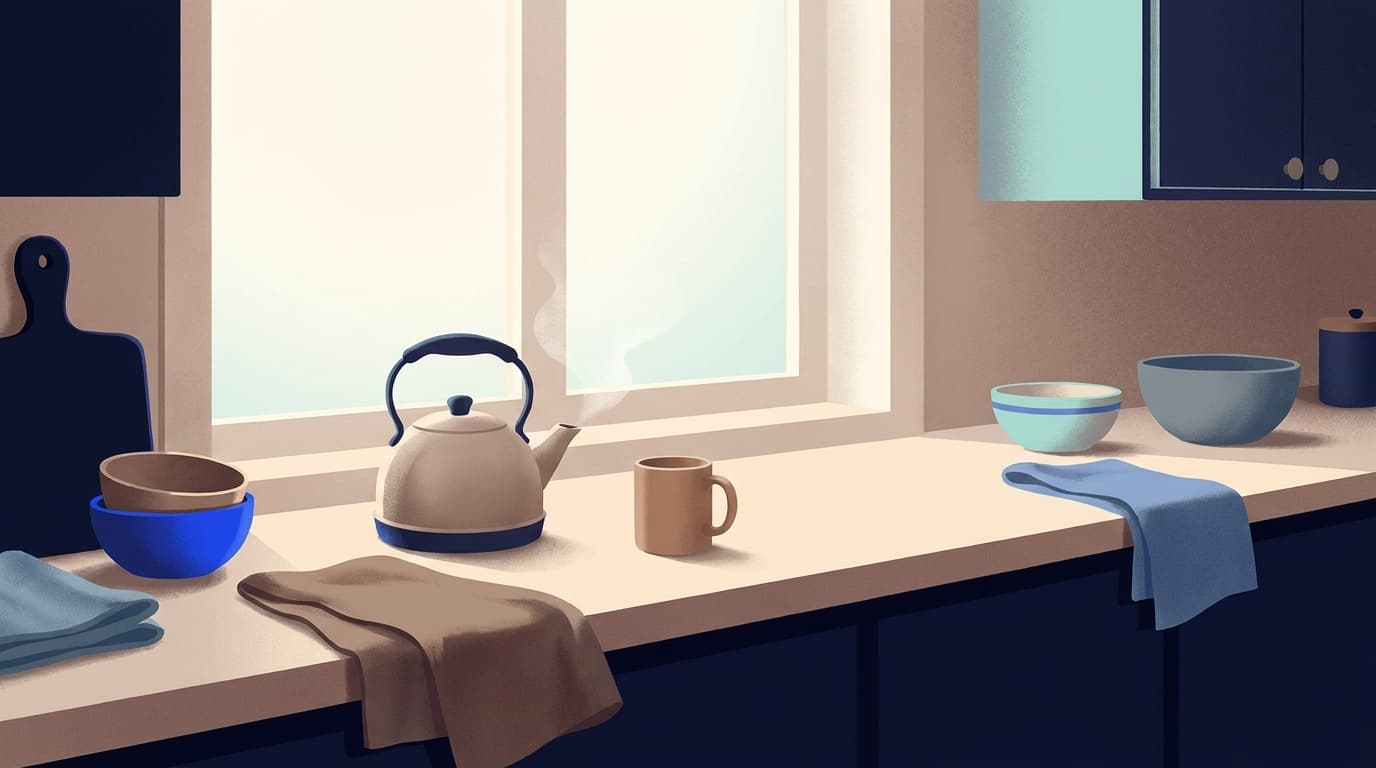
Choose one of those and attach your session to it. The kettle is a good one: it gives you a clear start, a clear end, and you are already standing still. So is the first few minutes after you sit down in the evening, before the programme starts.
Say it to yourself as a sentence. "After I put the kettle on, I do my holds." That sentence does more work than any reminder app.
2. Train sitting down, because that is where your day already happens
Many women assume the exercises have to be done lying on the floor. Lying down is useful early on, when you are still learning what the right muscles feel like, because gravity is not working against you. But it is also the position least available during a working day.
Once you can find the lift reliably, practise sitting upright on a firm chair, feet flat, weight on your sitting bones, not slumped back. The movement is the same: a gentle lift and close inwards and upwards, then a full release.
Sitting practice means your session fits at the kitchen table, at a desk, on a train, in a waiting room. No change of clothes, no floor space, nobody any the wiser.
3. Use the dead time you already have
There are pockets in every day where you are simply waiting. The lift. The supermarket queue. The traffic light. The two minutes while the microwave runs. These are not big enough for a proper session, and that is fine — they are good for single repetitions.
A single slow hold, released properly, is worth doing. Three of them while you wait for the kettle is worth doing. You are reminding the muscle, and more importantly reminding your brain where the muscle is.
Keep these separate in your head from your anchor session. Dead-time practice is a bonus. If you start counting it as the whole job, your training will quietly thin out to nothing.
4. Protect the rest, not just the squeeze
When time is short, the first thing people cut is the rest between repetitions. It feels like dead space. It is not. The release is half the exercise, and a muscle that never fully lets go gets tired and achy rather than stronger.
So if your minutes are tight, do fewer repetitions with full rest rather than more repetitions crammed together. Three good holds with a proper release each time beat ten rushed ones.
A useful check: after each hold, can you feel the muscle genuinely drop back down and settle? If you cannot, you are stacking tension, not training.
5. Put it where your body is already warm, not where your day is already full
Look at your day honestly and find the time when you are least likely to be interrupted and least likely to be exhausted. For many women that is early morning, before the house wakes up. For others it is mid-afternoon, or right after a shower.
Avoid the last fifteen minutes before bed if you are already falling asleep, and avoid the slot that is always hijacked by someone needing something. You are not looking for the time you *should* have. You are looking for the time you actually have.
If that slot turns out to be wrong after a week, move it. Changing the time is not failing. Abandoning the habit because the time was wrong is what costs you progress.
Also read: How Long Does Pelvic Floor Training Take? A Realistic Timeline, Stage by Stage · Why This Week Is Worse Than Last Week: 7 Reasons Pelvic Floor Progress Stalls

6. Build in the everyday squeeze — the one that does the real work
Separate from your session, there is a habit worth learning: tightening the pelvic floor just before the moments that put pressure on it. Before a cough. Before a sneeze. Before you lift the shopping out of the boot, or stand up from a low chair.
It takes no extra time at all, because those moments are already happening. You are simply adding a brace to something you were going to do anyway.
It takes a while to become automatic, and at first you will remember only afterwards. Keep going. This is one of the places where many women notice a real difference in daily life, long before anything else has changed.
7. Make the minimum version small enough that you never skip it
Some days there is no slot. Someone is ill, you are travelling, the day simply gets away from you. The habit survives those days only if you have a fallback version that is almost embarrassingly small.
Decide now what yours is. Three slow holds, sitting, wherever you are. That is it. On a bad day you do the minimum and you have still kept the thread intact.
Consistency over months matters more than intensity on any single day. The women who improve are generally not the ones who did the most in one week. They are the ones who were still doing something in week twelve.
8. Track it in the simplest way you will actually keep up
You need some way of knowing whether you did it, because memory is generous and will tell you that you have been doing it all week when you have done it twice.
A mark on the kitchen calendar is enough. A guided programme that prompts you and keeps the count is easier again, because it removes the decision about what to do today. Whatever you choose, it should take seconds, not thought.
Look at the record once a week, not once a day. You are checking a pattern, not grading yourself.
What to expect from a few honest minutes
Short sessions done most days work better than long sessions done occasionally. That is good news when your day is full, because it means the barrier is low.
Progress is slow and unglamorous. It usually shows up first in small things: a sneeze that does not worry you, a walk to the car without a calculation. Those are real signs, and they are worth noticing when they come.
Pick your anchor today. Say the sentence out loud — after I do X, I do my holds. Then let the next week tell you whether the slot was right, and adjust. Anything that feels wrong in your body — pain, a new heaviness or bulge, blood, a sudden change in your bladder — goes to your doctor first, not into your training plan.